The Invisible Engine of Growth: How Embedded Finance Unlocks Global Potential
The best payments experience is the one your customers never notice, because everything is already working. PingPong built its platform on over a decade of payment infrastructure investment, and is now embedding that foundation directly into the products and ecosystems our partners operate. The result: payments that disappear into the experience, freeing businesses to scale without the complexity.
By Wayne Chen, Product Director
Over a decade ago, PingPong set out to solve a problem that most businesses at the time accepted as inevitable: slow, opaque, and expensive money movement across borders.
We invested where others hesitated – in local payment networks, regulatory licenses, a proprietary FX engine, payout logic, and settlement rails. In doing so, we created more than just a product layer, establishing a load-bearing foundation to flexibly support our partners' business models. The unglamorous infrastructure that many fintechs prefer not to think about.
And over time, serving customers across markets and industries, we noticed something counterintuitive.
Our happiest customers were the ones who never had to think about us.
Not because nothing was happening, but because everything was. Funds were settling. FX was converting. Compliance was clearing. Payouts were landing. Quietly, predictably, without friction, or distraction.
That realization changed how we thought about our role.
If the best payments experience is invisible, infrastructure alone isn't enough. It has to live inside the products where businesses already operate.
This is what led us to create the PingPong Platform: taking the infrastructure we've spent over a decade refining and embedding it directly into the ecosystems and workflows our partners build.
Imagine a world where your customers never have to think about payments. They don't open separate banking apps, manually reconcile statements, or navigate clunky, third-party checkout pages. Instead, every financial function—getting paid, paying others, managing funds—feels like a natural, extension of your product.
When payments are built in, not bolted on, scale becomes sustainable. You regain the focus on perfecting your core offering while payment and cross-border complexity is handled beneath the surface.
In doing so, they become an accelerant for growth rather than a barrier to it.
The Old World: A Story of Friction
To understand the power of this shift, let's look at the old world. In the traditional model, complexity is your default setting.
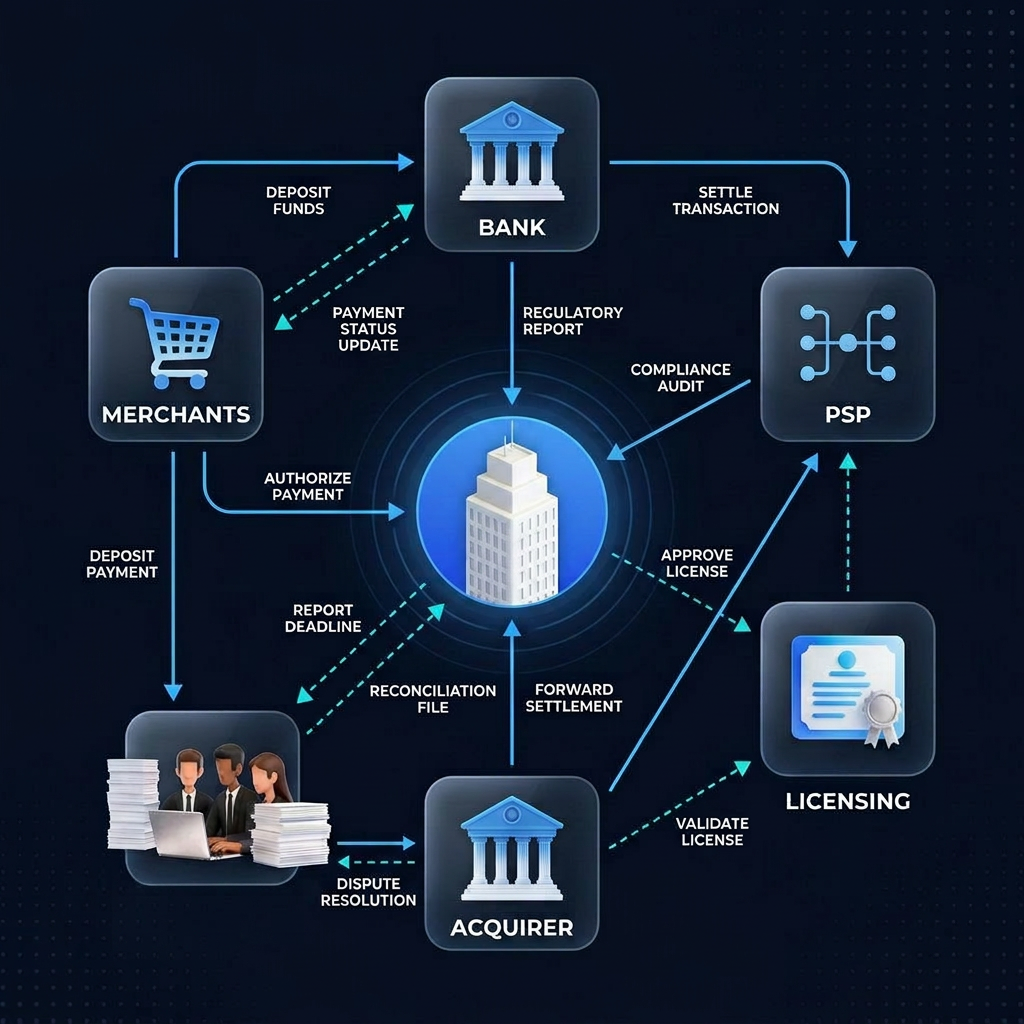
For your users, the merchants and partners on your platform: They face a daunting maze. They must open local bank accounts in every country they sell to, establish relationships with regional payment providers, and then spend hours manually reconciling a storm of transaction records against their bank statements. It's time-consuming, expensive, and riddled with hidden fees – not to mention opaque but significant FX costs when juggling various regions and currencies.
For you, the platform: The burden is equally heavy. Your team becomes a logistics company for money, sourcing and managing payout partners in every new market. Your finance department drowns in spreadsheets, manually aggregating data from multiple channels just to track sales. And as you scale, the complexity multiplies, introducing a minefield of compliance, licensing, and regulatory considerations, slowing down your expansion plans.
The New World: Integrated, Invisible, Intelligent
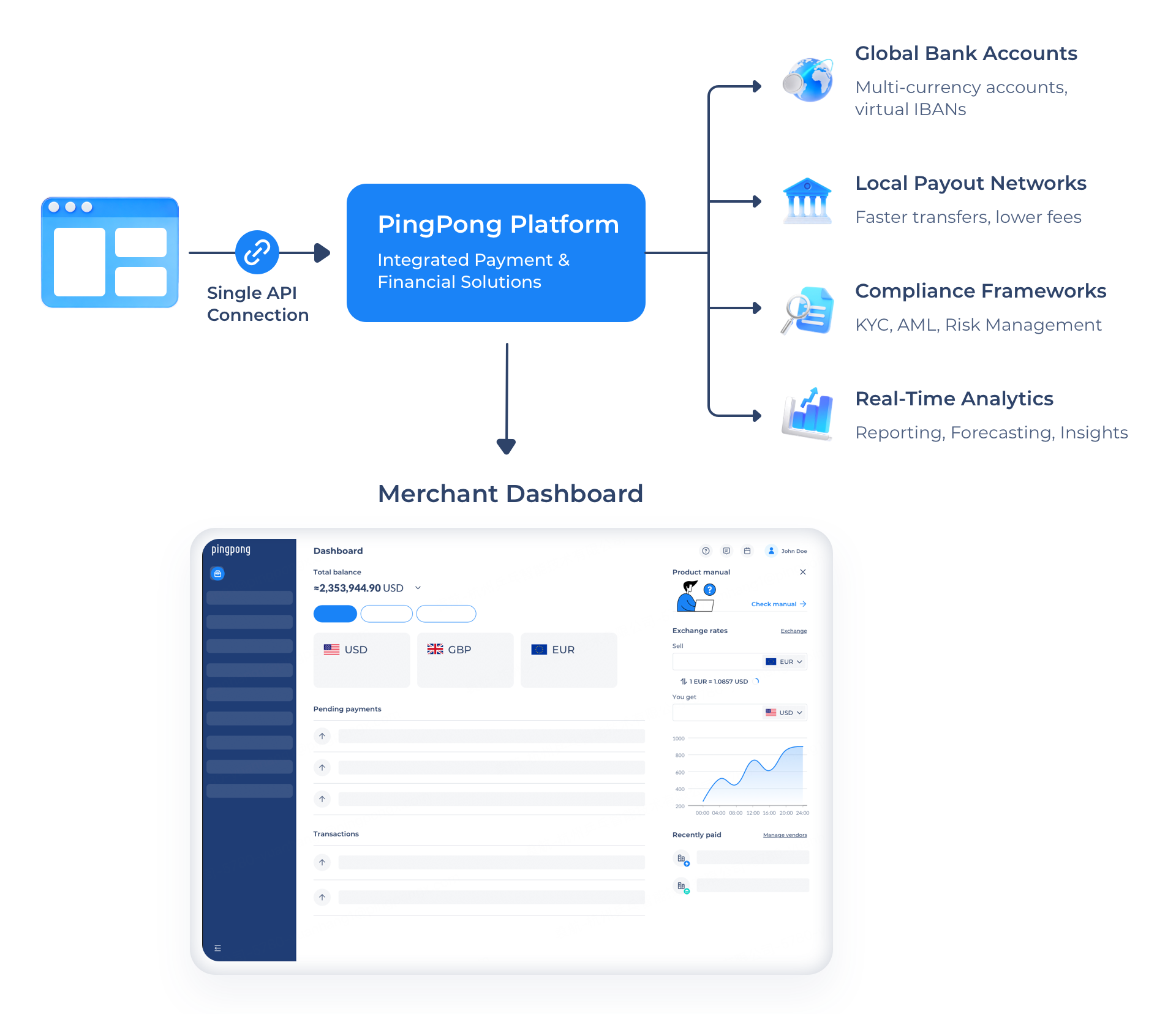
Now, imagine a different world. One where a single integration unlocks a global financial network.
In this new model, the financial plumbing fades into the background, but its impact is profound.
For your customers and partners, the experience is seamless. From fast, automated onboarding to payment preferences, and tracking everything from within your ecosystem. Your platform becomes sticky and indispensable.
For your operations and finance teams, the nightmare of reconciliation and vendor management disappears. They gain a single source of truth for all transactions, automated reporting, and consolidated financial control.
For your product and tech teams, they regain the most precious resource: focus. This allows them to stop maintaining complexity and invest the time and talent into innovating core product differentiators.
Beyond Marketplaces: Embedded Finance Across Industries
The need to orchestrate complex, multi-party financial flows is universal. Here are just a few examples of how this model applies across different sectors:
1. Service Platforms
The Scenario: A global SaaS company needs to collect subscription payments in multiple currencies. A clinical research firm must pay trial volunteers across borders. An online education platform manages student tuition and instructor payouts.
The Opportunity: Embedded finance provides the account structures to manage complex client or partner funds, mass onboarding tools for swift KYC, and the ability to move money globally—all through a branded, in-product experience.
2. Travel & Hospitality
The Scenario: A global OTA needs to collect booking payments across dozens of markets while simultaneously settling with hotels, tour operators, and local suppliers in their preferred currencies. A hospitality technology platform manages payment flows between online travel agencies and hundreds of suppliers across multiple jurisdictions.
The Opportunity: Local collection accounts and virtual IBANs allow travel businesses to collect and settle in-market — paying suppliers same-day in local currency, securing better inventory and rates as a result. FX optimization built into the settlement flow removes the cost drag that makes cross-border expansion feel financially risky. And a single API connecting collections, conversions, and payouts replaces the fragmented multi-provider stack most travel companies are running today by reducing integration costs, eliminating interoperability failures, and giving finance teams a unified view of money movement across every market they operate in.
3. Corporate Treasury
The Scenario: A multinational corporation needs to optimize cash flow across subsidiaries, manage supplier payments in multiple currencies, and centralize global receivables.
The Opportunity: A unified platform provides visibility and control, enabling global receivables management, improving margins from competitive FX rates, and streamlined payments across the entire corporate group and supply chain.
How Market Leaders Are Making It Happen
The companies building these experiences aren't becoming banks themselves. Instead, they are partnering with specialized financial infrastructure platforms that provide this as a foundational layer. Market leaders in this space don't just offer point solutions; they provide a comprehensive, full-stack approach, including:
Core Payment Products: Global acquiring, multi-currency collections, cross-border payouts, and transparent foreign exchange.
Flexible Business Modeling: Account and ledger structures that can mirror complex ecosystems.
Embedded Compliance: Integrated KYC/KYB tools and licensing support that reduce the regulatory burden of operating in multiple jurisdictions.
Extended Financial Services: Building blocks like supply chain finance and card issuing that allow businesses to evolve their financial offerings as they grow.
Instead of building and maintaining payments infrastructure from scratch, they can focus on what they do best: refining their product and serving their users. When payments disappear into the product experience, your users stay focused on the value you provide. And your team stays focused on building what sets you apart.
That’s why we built the PingPong Platform. To help global businesses stop wrestling with payments and start scaling with confidence.
Because when money moves exactly as it should, your product gets all the attention.
Ready to unlock the power of the PingPong Platform?